Post-humanist nods at #BAAL2022
In two plenaries at the British Association of Applied Linguistics 2022 conference the notion of post-humanism is raised in passing.
For example this slide in one plenary (which I commented on previously):
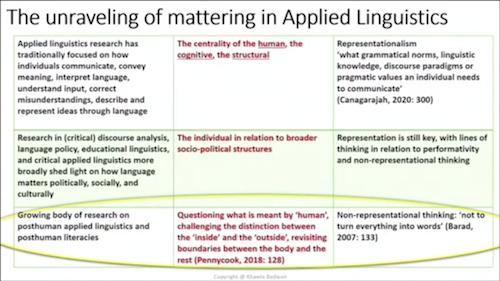
Another plenary by Professor Ahmad Mahboob refers to it more:
"Because linguistics has categorised these theories of language which are essentially anthropocentric. And my indigenous self rejects anything that is anthropocentric. Anything that is human-centric whether it's linguistics or biology which also by the way does the same thing. Biology does not define life, they talk about the characteristic of living things and they use those characteristics to create the discipline of biology without defining life. Just like linguists don't define language. They create the discipline of linguistics based on a contrast between human language and non-human communication. That's it that's how they create the whole discipline. When I see that happening my indigenous roots reject it. I cannot accept it I have to create something different." (1:16:28 - 2:09:03)
He explained previously when talking about introductory linguistic textbooks:
"Now in both these textbooks what you notice is the textbooks start by separating out human language with non-human communication. So humans have language, non-humans have communication. Right, notice the discipline is doing it. It is the discipline of linguistics that's creating a distinction between human language and non-human communication." (1:13:25 - 1:13:53)
Mahboob is probably drawing on Curnow (2009: 37) who found from a survey of 10 introductory linguistic textbooks:
"In fact, in most cases this use of communication is implicitly opposed to language, with constant repetition in many of the texts contrasting ‘animal communication’ with ‘(human) language’, leading to the idea that language is different from communication."
This linguistic distinction is based on a much older one, namely that of the human-animal divide.
According to Worsham (2013) as quoted by Kwok (2020: 62):
"One way of explaining the civilised construal of human-animal hierarchy is to treat it as a post-traumatic need. Worsham (2013) describes our ancestors' trauma of being animals' preys instead of predators in pre-historic and early historic human-animal relations. This distressing feeling of vulnerability, combined with humans' fear of their own animality, is what incubates humans' urge to separate themselves from the wild beasts."
Mahboob when talking about linguistics is most probably referring to the tradition descending from Saussurean linguistics since he reminds the audience:
"Interestingly enough linguistics and applied linguistics as disciplines as departments within the university are a very new thing. Linguistics departments...has existed less than 100 years, maybe 70 years or so and applied linguistics are even newer." (1:15:37 - 1:15:54)
Saussurean linguistics makes the distinction between human and animals based on the notion that each human "is entrapped in a psychological reality, that is their own specific language which forces them to think that they are different from animals" (Kwok 2020: 65). This position differs from earlier ones on the human-animal relation in Western thought, which marked humans as possessing the special ability of: rationality (Ancient Greek thought, the New Atheists); speech (Aristotle); language (Enlightenment thought & generativists); consciousness (Daniel Dennett & the New Atheists).
Yet he seems to be also subscribing to Saussurean premises i.e. humans are "embedded in a historically grown collective mental structure" (Pable 2016: 41) when giving the example of the word boli :
"In my mother tongue we actually don't have a word called language. We use the word language from English we borrow it. In my own mother tongue we have a term called boli in English is speech. And boli is not restricted to humans we say cows can have boli, sheep have boli, trees have boli, birds have boli, everything has boli." (1:14:39 - 2:09:03)
Although a post-humanist turn aims to live up to its name, Kwok (2020) shows that post-humanism is inseparable from humanism. Take for example the study of the bee dance that is used to help bees find food sources and is often used as a example of strong post-humanism - that is humans are not the only ones to have a language, animals do too. Kwok (2020: 67) points out that a psuedo-Saussurean framework is imposed in order to say bees have a language:
"This is done through positing and designing of a psychological reality that is the common language system containing fixed signs shared by forager bees, an abstract code that is believed to be used for information transmission between a sender and receiver in a typically telementational fashion."
Further, proponents for and against the claim that bees have language use human language as a yardstick - supporters for a bee language that it shows the property of displacement; naysayers against bee language that it does not show the property of productivity.
Kwok (2020) goes on to show that weaker post-humanist claims that animals use some kind of sign system to communicate is still framed in humanist perspectives. She takes the case of alarm calls in vervet monkeys where analysts use: surrogational semantics (monkey can refer to objects in the external world, alarm calls trigger corresponding mental concepts in the monkey's minds); Gricean intention theory; and information theory.
Kwok (2020: 68) sums up the situation:
"The more critical posthumanism acknowledges that the posthuman path is a slippery slope back to humanism."
References:
Curnow, T. J. (2009). Communication in introductory linguistics. Australian Journal of Linguistics, 29(1), 27-43.
Kwok, S. (2020). The human-animal divide in communication: anthropocentric, posthuman and integrationist answers. Language & Communication, 74, 61-73.
Pablé, A. (2016). Global semiotics vs. human semiology. Chinese Semiotic Studies, 12(1), 25-43. Retrieved from https://www.degruyter.com/document/doi/10.1515/css-2016-0004/html